Stay Environmentally Friendly
Thursday, March 15, 2012
The Donation of Excess Food From Bates
Finally, after working this whole semester I have finally found an organization that is willing to accept and pick up donations of excess food from Bates. Enough food is wasted there on a daily basis to feed twenty people. The next thing we have to do is speak with the college. I know they will agree to it.


Friday, March 2, 2012
An Introduction
Hello! This is a post to introduce myself – My name is Jay. I’m a first year at Sarah Lawrence College, and as a new member of the Compost Club I’m going to be writing updates on the blog from a compost newbie perspective. The idea is that hopefully as I learn more about composting and write updates about it, others can learn with me. I’ll be posting updates about how composting is going here at Sarah Lawrence, but also general information about composting, how it helps the world, maybe some current events… We’ll see!
Why am doing this? Well, I’m taking a class called Political Economics of the Environment with Marilyn Power (really awesome class), and after learning about so many of the terrible environmental issues going on in our world, it’s hard to not want to do something. Composting certainly helps with a lot of really big environmental problems like keeping our topsoil full of nutrients so we can continue growing food, lessening our reliance on synthetic fertilizers that leach into ground water and cause massive algae growths that choke up sea life, reducing waste and global warming effects…The list goes on. So hopefully I can help build support for composting and all the good stuff it does.
Alright, until next time.
Jay
Tuesday, February 21, 2012
Full Bin Now What?
Hmm... so the compost bin is full.... a screening of Dirt! The Movie will be screening this Saturday February 25 2012 at 6 PM in Titsworth Lecture Hall at Sarah Lawrence College. What next? We have this big event, raise awareness of the importance of dirt and compost underneath, and then what? That compost needs to get sold, and it needs to see use. What about donating it to a small community garden for starts? What about selling it?
On a different note, did you know? Moss has been shown to decrease leaching of nitrogen fertilizers by as much as 95%? There was a study published about it in page
On a different note, did you know? Moss has been shown to decrease leaching of nitrogen fertilizers by as much as 95%? There was a study published about it in page
Friday, October 14, 2011
Why does SLC (Sarah Lawrence College) Say We Need Insurance to Sell Compost?
On the insurance, one thing I do not understand about insuring compost
sales at SLC is if students can sell baked goods at SLC without using
insurance and customers are actually eating these things then how can
compost, an item that is not even going to be consumed going to prove a
liability in comparison to other clubs that have made sales or even at
the teahaus which sells baked goods. Yes AVI and farmers at Farmers'
markets have insurance on their food sales but they are much larger
scale yet student clubs doing bake sales don't need insurance so why
should compost clubs need to do so? Especially when even the largest
composting facilities in the country don't get insurance on their
compost and they handle much more difficult food items than we do.
Dan Vecsi was a guy I visited who manages the Wilmington Organic Recycling Center, if I'm not mistaken one of the largest composting facilities on the east coast. He told me that insurance was not necessary to purchase for the sale of compost but was an option to look into. He did take regular soil tests and while these tests might be worth doing, I'm unsure of how important they would be for something at such a scale. I also called up the Lower East Side Ecology Center which sells compost in the farmers' markets at Union Square and they said that insurance for selling compost was not necessary as well.
Finally, what is important about allowing sales of compost at SLC is that composting is a grueling job. Why is it that in our society we would pay a student working in the music library or the gym 7-8 dollars an hour to check their facebook status and do their homework, but yet for a student who has to carry heavy buckets of smelly food waste day in and out, and stain several sets of clothes to carry this stuff, it should just be considered an unpaid job? This does not sound like a very just way of valuing one's work. It is a sad, unfortunate tiding to know that composting is such an atrociously undervalued service.
Dan Vecsi was a guy I visited who manages the Wilmington Organic Recycling Center, if I'm not mistaken one of the largest composting facilities on the east coast. He told me that insurance was not necessary to purchase for the sale of compost but was an option to look into. He did take regular soil tests and while these tests might be worth doing, I'm unsure of how important they would be for something at such a scale. I also called up the Lower East Side Ecology Center which sells compost in the farmers' markets at Union Square and they said that insurance for selling compost was not necessary as well.
Finally, what is important about allowing sales of compost at SLC is that composting is a grueling job. Why is it that in our society we would pay a student working in the music library or the gym 7-8 dollars an hour to check their facebook status and do their homework, but yet for a student who has to carry heavy buckets of smelly food waste day in and out, and stain several sets of clothes to carry this stuff, it should just be considered an unpaid job? This does not sound like a very just way of valuing one's work. It is a sad, unfortunate tiding to know that composting is such an atrociously undervalued service.
Monday, October 10, 2011
Our Composting Progress
As of this fall 2011 schoolyear we have
- Sold 12 clothes drying racks
- Composted nearly 1,000 pounds of food waste
- Secured a new grant from Sarah Lawrence College (SLC)
- Created a compost club at SLC
- Collected 70 members on email list and have 5 people actively showing up and committing to the club
- Have complete support for composting on a small scale at SLC only waiting for pending approval this coming Wednesday
- 2 Students doing a conference projects relating to compost this summer other than me
- Weighed food at Bates Dining Hall and reached out to numerous people in the college
- Created several stickers which are now up on campus promoting environmentalism and our club
- Have given tours of our composting site to more people this year than all of last year combined
- Am doing an independent study to focus on the best type of full-scale composting facility at SLC
- Admissions office at SLC now mentions our club in tours of the college and has raised a lot of interest in the club
- Now have students helping compost on campus on a pilot scale, and am beginning to show students leadership skills in making composting happen on campus.
Sunday, September 11, 2011
We are getting profiled at SLC!! We had our first compost club meeting today. We gathered some awesome ideas about how to get composting plans on campus done and now, I will write up a proposal to pitch to the committee for student life with Ellie Mae. She will be writing a gardening portion of this. Ellie, the co-chair of the composting club, went on an awesome farming adventure this summer, and she misses it so much it's sad. Check out her blog for info about that great farm. Probably our next important talk will be about compost club t-shirts. I will negotiate a deal with some t-shirt vendor custom designer use organic cotton and fair-trade methods. There is a particular place in mind about that.... coming soon.
Anyone interested in gardening should email me at ecolasante@gm.slc.edu. Ellie Mae is initiating a garden at SLC with 5X5 foot plots (or even persuade the college to allow us to use space in the green house). We would make a hoop house over these plots for the winter months, and students would likely maintain the garden every week. By paying a certain amount to start it, we will equip them with what they need, offer them guidance and a space, and funnel funds into composting and gardening at SLC.
Recently we just got profiled at SLC Speaks
Anyone interested in gardening should email me at ecolasante@gm.slc.edu. Ellie Mae is initiating a garden at SLC with 5X5 foot plots (or even persuade the college to allow us to use space in the green house). We would make a hoop house over these plots for the winter months, and students would likely maintain the garden every week. By paying a certain amount to start it, we will equip them with what they need, offer them guidance and a space, and funnel funds into composting and gardening at SLC.
Recently we just got profiled at SLC Speaks
Saturday, September 3, 2011
Tarsands Action-Compost
Seeing a picture of my arrest may understandably be a little
jaw-dropping. I was demonstrating in front of the White House in Washington, DC
for Tarsands Action participating in an act of Civil Disobedience. Given the
power oil has over the world, protesting the construction of an oil pipeline
over 2,000 miles long across the US is no easy task.
The proposed pipeline, extending from what’s now endless miles of deep
forests occupied by several indigenous tribes to as far south as Texas would be
what some scientists denote as the “Carbon Bomb.” In other words the world has
burned so much fossil fuel already, and is already scheduled to release so much
more fossil fuel emissions, a pipeline as bold as this would, according to Bill McKibben
seriously jeapordize the environment. For obvious reasons, burning oil would
add extra carbon dioxide emissions to the atmosphere. However, the process of
extracting oil from a mixture of sand, tar, and crude oil is also a much more
energy-intensive process. Compounding, is the fact that Canada’s forests also
lock carbon, not only into the trees, but also in the soil and peat moss below. That’s the carbon
problem. Other reasons to oppose it include the displacement, once again of
indigenous people from their land and way of life not just in Canada, but also
in the US, seeing the proposed pipeline would cross Native American
reservations in the US. Containing a long list of highly toxic chemicals, the
extraction process would release these chemicals, contaminating the area around
it for hundreds possibly even thousands of miles. While Transcanada touts its
pipeline has the highest safety standards to date, several pipelines have gone
leaking as recently as the past year, including one that leaked twelve times just 2010 alone.
Barring all of these reasons, I also opposed it because Obama made a
promise to address climate change in a serious way, yet his presidency has come
to a near end and he has barely done anything to address climate change. Obama
neglected to use his energy to help pass a carbon tax which failed to pass,
neither have serious subsidies on renewable energy been considered or seriously
pushed by him, and a higher fuel efficiency standard for cars might pass, but
how likely? Who knows, and little has come of that bill as a result of Obama’s
leadership. While Obama may blame Congress, and Congress may be blame-worthy,
this is one situation for the environment in which Obama could act. The only
way an oil pipeline could cross Canada to the US would be if the president
signed for it. If he chooses to say no, the pipeline won’t get built. Given the
pressure for jobs, the economy, and the oil lobbyists, whether he would refuse
to sign it is so questionable many articles are bold enough to state that the
demonstration I participated in would not be enough to pressure him to say no.
How could several hundred peaceful
demonstrators sitting in front of the White House over the span of 2 weeks get
arrested? Good question. There is a law stating that no one is allowed to sit
in front of the white house because they would destroy the post-card view for
the tourists. People can walk across it, but they cannot stand or sit for
longer than ten minutes or something like that. Thus when we decided to stand
and sit in front of the White House, the police immediately cordoned off the
area, and gave several warnings requesting demonstrators to leave. When they
and I refused, showing our act of civil disobedience, they then proceeded to
arrest us. Crowds of people chanted with us and cheered each time the police
handcuffed someone. In my arrest picture I was leading the crowd in a chant,
“When I say tarsands you say no Tarsands! No! Tarsands! No! When I say pipeline
you say no! Pipeline! No! Pipeline! No!” I also chanted “Stop the tarsands stop
the greed give the people what they need!” as they took my mug shot. I led
chants for the crowd from the police caravan the entire hour I sat there
waiting for the rest of my fellows to get arrested. The police arrested all the
women first, but I was arrested with the women because I was taking such an
active role in leading the chants. The police then gave me a personal chauffer
to haul me off to prison. Since the crowd could still hear me from the car, I
just kept leading the chants from the car too! Well, why not? Nothing like
screaming your head off in handcuffs for a cause you believe in! Also, the
government should be reminded that it is required to serve the people and
respect their rights to protest.
No court hearing was taken, the police ran out of space at the Anacostia
prison so they just gave us a post and forfeit option, which means no charges
on my permanent record, but I’ve better not interfere with the law for another
90 days. None of us saw a jail cell-the first protesters were kept for 3 days
and had to show up to a court hearing, however, seeing civil disobedience is so
routine in Washington DC and that there were just too many of us, I was
released from my handcuffs within 3 hours. The activist group leaders gave us
snacks and drinks outside the Anacostia Prison.
What does a demonstration against an
oil pipeline have to do with composting though? Well, I would argue everything
in the world is connected in one strange way or another; therefore, it is
essential to throw in an article about something a little out of the box
occasionally no matter how off-topic it may appear. Given the fact that
production of ammonia for fertilizer requires 1-3 percent of the world’s energy
production (it’s a very heat-intensive process), and that just one day of
mining another vital plant nutrient for chemical fertilizers, phosphorus, uses
enough energy to power over 150 American homes for a month, it may be worth
arguing the composting is in at least in an indirect way, a source of renewable
energy for the planet. For the biogas facility getting drawn up for SLC, it can
provide a source of methane which can be burned for heat and electricity.
Tuesday, August 23, 2011
Photos of the Tarsands Arrests
You'll get more info on this very shortly. Here are some awesome pics. The explaining comes in a bit!
Eli Arrest
Eli Arrest
Sunday, August 21, 2011
Is Compost a Weapon of Mass Destruction?
Recently in April of 2011, I was composting in my dorm room at Sarah Lawrence College. This was a breach to my promise the semester before not to compost in my room, but in a way I'm really glad to have broken the rule even with the penalties I faced because of the interesting topic we will discuss today. Is compost a weapon of mass-destruction? Of course, the short answer is no, but for a detailed and grounded answer you will just have to read below.
One bright sunny day in April at Sarah Lawrence College, the fire alarm went off for no apparent reason in my dorm room. It has done this before and the firemen have come up and inspected the whole house I was in and never cared about the compost in my room in the past. However, the second time, I was fighting a serious odor problem in my compost bins so upon the firemens’ finding that smell, they immediately told the college that this compost had to leave my room because it was an “explosive device.” I quickly arrived to the scene, and the firemen and security guards both gave long-winded explanations about how compost actually can set fire to homes, and could cause major explosions. I then tried telling some students about this at my college in a tone of ridicule because after all, how could something as innocent as a pile of food waste and paper turn into an explosive device? I would have thought my fellow peers would have considered this a laughing matter. Instead, they believed that compost is an “explosive device.” Before deciding to ridicule them, it might be worth looking at the merits to their line of reasoning.
For instance, chemical fertilizers originated from poison gas and chemical explosives used in World Wars I and II. Chemical fertilizers are also explosive and poisonous chemicals. Therefore, it might follow that since compost, the finished produce, works as a fertilizer. That’s reason one. Second, if food waste does not get mixed with a fair proportion of goods containing a lot of fiber, it does release ammonia, another detailed explanation that would need another post another day but is at least a noxious gas. Third, even if food waste is mixed with the right proportion of goods to produce fiber, if it doesn’t get enough oxygen, organisms that don’t need oxygen to break down food waste will prevail and those organisms will produce methane instead of the carbon dioxide that organisms requiring oxygen will produce. As some environmental enthusiasts may know, both of methane and carbon dioxide are greenhouse gases. This question will also be debated in a future blog. For now, it’s just important to know that methane is a highly flammable gas that could, in theory explode or set a house on fire if in high enough concentrations.
Now we will dissect each of these putative views. For methane, allow me to point out that while a small, household compost bin poorly managed may release a trace amount of methane or ammonia over a long period of time, but never enough at any one time to cause any serious problems. The Lower East Side Ecology center in New York City among numerous other organizations spanning the world encourage people to compost indoors or in their own apartments. If fumes are to be considered a serious problem it might also be worth deciding whether anyone should use gas stations, drive cars or keep gas stoves. There are plenty of cases concerned with leaving on a gas stove, which then results in the striking of a match and a subsequent house explosion. There are plenty of cases of car/plane explosions from a full tank of gas. For example the Septmber, 11 tragedy was largely successful due to the planes’ having a full tank of gas, which then set the World Trade Center aflame. Similar attacks using suicide bombers in cars are commonplace. Anyone ever heard of a small 18 gallon compost bin burning down a skyscraper? Neither have I.
The fact that compost contains chemicals for fertilizing plants just like chemical fertilizers would therefore make them explosive, right? Well… if compost were a pile of chemicals like chemical fertilizers sure, but compost is not. Compost is complex system of organisms much like a forest. In fact 2/3 of all biodiversity on Earth live in soil and compost. Sure there is plenty of nitrogen phosphorus and potassium in compost, BUT the, nitrogen is found in the form of proteins and enzymes in bacteria and other living organisms, phosphorus is found in the cell membranes, and potassium is contained otherwise in organisms. Therefore, the vast majority of soil nutrients at any one time in compost are not available in a water-soluble form. Instead, plants secrete sugars which attract all of the bacteria which contain the nitrogen phosphorus and potassium. The bacteria get attracted and then their predators, protozoa kill off the bacteria and eat them. In the process, they leave a large soup of water-soluble nitrogen, phosphorus, potassium and other vital nutrients. However, plants would never attract more bacteria than they actually need because that would be a waste of the sugar that took so much work for them to produce through photosynthesis. Therefore, there’s no way for finished compost to contain poisonous chemicals the way chemical fertilizers have. This allows plants to get the exact amount of nutrients they need whenever they need them, in any form they want. That’s the benefit compost has, over chemical fertilizers. That’s one of many benefits, which won’t all be explained here.
Many might believe composting bacteria can make you sick. That may be true if your compost pile does not heat up enough and if you compost food waste containing pathogenic organisms such as meat or food from peoples’ mouths, etc. However, the composting process itself does not add pathogenic organisms because compost organisms are not pathogenic. Even the pathogenic organisms in compost would never get consumed and would ultimately get outcompeted for food by the large city of compost organisms. Compost goes on plant soil, and plants then get eaten. By then, the pathogens would be gone unless you were trying to compost human sewage or cat/dog feces. Composting organisms are not in and of themselves pathogens. They are stuck with very specific jobs of converting proteins, sugars, and complex lignin into humus and a vast array of organisms. Regardless bacteria cannot “explode” or catch on fire the way ammonia or other chemical counterparts can.
Thursday, August 18, 2011
Identify the Impossible, then Make it Happen
Check out this article on us. By the way, that subject above will make our purpose. A purpose is not a goal. Instead it's a direction. It's not really a desire, or a concrete thing but well... a purpose. It's a direction like north south, east or west. You can keep going those directions forever just as you can with a purpose. http://compostforbrooklyn.org/2011/08/16/identify-the-impossible-then-make-it-happen/
Visit to Dickinson College
Dickinson College, located a in Carlisle Pennsylvania just a few miles outside Harrisburg, shows a clear example of the true potentials of composting at college. With a college population of 2,000 people, Dickinson college compost about 700 pounds of food waste a day, making about 68,600 pounds of food waste per semester. Seeing the college also composts other food waste from restaurants, and a beer brewing facility (used grain and wheat), this number is actually a lot higher. Despite the enormous amount of food waste composted, I was really surprised to learn about just how little land was needed to compost it.
Using only 4 windrows about as tall as an average-height full-grown adult, and as long as two classrooms, the entire facility only needs about a half acre to compost. At Sarah Lawrence College where we only have only 1,200 students and faculty, the amount of land needed even if we used windrows would be substantially lower!
Food waste first gets carried on a conveyor-belt device looking like this in the dining hall.


The machine then throws the pulp into these green buckets. I would opt to use those five gallon buckets always getting thrown away at Bates dining. Good lids for them may still be necessary, but I may be able to find those without too much hassle.


Using only 4 windrows about as tall as an average-height full-grown adult, and as long as two classrooms, the entire facility only needs about a half acre to compost. At Sarah Lawrence College where we only have only 1,200 students and faculty, the amount of land needed even if we used windrows would be substantially lower!
Food waste first gets carried on a conveyor-belt device looking like this in the dining hall.

Then it gets taken into a machine looking like this. The machine grinds up the food waste, extracts excess water, and turns the food waste, meat, bones, fats, and the like into a fine pulp.

The machine then throws the pulp into these green buckets. I would opt to use those five gallon buckets always getting thrown away at Bates dining. Good lids for them may still be necessary, but I may be able to find those without too much hassle.

There is then a regular shift of students who commute from the dining hall to the farm, owned by Dickinson college located a few miles away by pickup truck. The food waste then gets mixed with a mixture of mulch and and leaves. The compost gets dumped onto windrows looking like this. Once the compost pile has been cooking a front-loading tractor, powered by biodiesel produced by Dickinson college (this was another student and faculty initiated endeavor) then turns it to aerate it. A black, vinyl-like cloth then covers the pile to allow air in, retain moisture, and retain heat. The heat kills off pathogenic organisms and results in finished compost. Dickinson college actually is exploring the option of getting a compost turner which would look like this to turn food waste much more quickly. There is also not enough compost being made to handle all of the college's compost needs so the college is exploring other food waste sources.
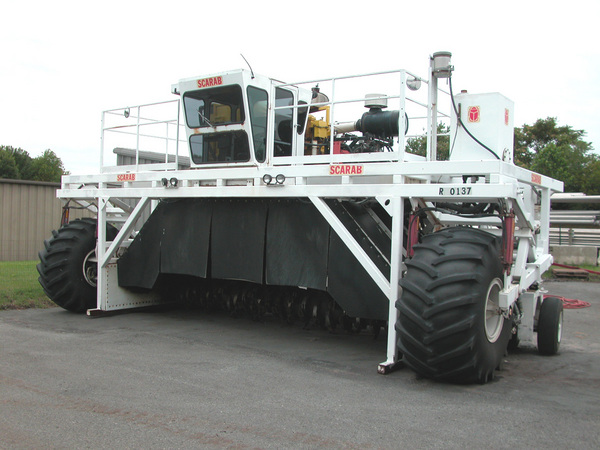

The composting facility was originally student initiated. The college, being supportive of the project, helped formulate plans. A grant proposal was then sent to the Pennsylvania Department of Environmental Protection. The first proposal was rejected but the second proposal was accepted and now the project has been going on since about 2002.
While windrows are a really cost-effective means of composting, and space may be made for them at Sarah Lawrence College, rodents will still be a problem in the New York Metropolitan area. From travels to various composting facilities in the area, rodents have made their homes even in piles of leaves that sat out for too long. In addition, once rodents are there, they are hard to get rid of, they spread food waste everywhere, causing various pest control problems, disease-spreading problems and other issues. Therefore, it may cost more to enclose it but, hopefully a biogas facility that encloses food waste and fiber, and produces energy can help off-set those costs. Nevertheless, the food grinding machine looks very effective for a college dining hall setting, and, unlike a garbage disposal, looks much less likely to break from high usage.
Saturday, August 13, 2011
Project 309 8/13/2011
Visiting the composting bin today, I still decided not to add more food waste or paper. However, since worms do appreciate a small amount of sand for their guts, I made sure to add several handfuls to the top of the composting mass. The rewards from my not stirring up the bin are now showing themselves. A new worm appeared, though I don't know what that white foam in the back was for.
Composting Visit
Today I visited Added Value Community Farm in Red Hook, Brooklyn, New York. There was really smart, informative guy there named David. Definitely volunteer and ask to visit if you'd like to learn more about composting.
Located on an abandoned sea of pavement, I dismounted my bike onto a cool patch of shade to be greeted by two wonderful managers who then put me to work and told me David might come in today. Upon David's arrival, a small series of plastic composting bins, and rotating drums first caught my eye. Mainly for people in surrounding areas interested in bringing their food scraps to be composted, David kept a long range of neatly printed signs informing these amateur composters to add the equivalent amount of leaves to the equivalent amount of food waste they bring to be composted. Sitting directly left of these bins lied a series of three large 1/2 inch hardware cloth covered wooden frames filled with composting food waste easily soaring above 100 degrees fahrenheit-that is without having been turned in at least a week. A wall of these bins gets taken off, and, to turn it, an individual just simply shovels the composting material into the next neighboring twin frame. Taking a total of 3 weeks to decompose, this stuff makes perfect compost for worms who live in a home very familiar to us, the OSCR worm composting bin.
When asked, David remarked that these composting bins were "a little fussy." That is to say, for some reason they worms tolerated a lot less turning than worms eating food waste in much smaller bins. My experience upholds his findings. He continues to remark that the OSCR bins rely on a very stratified set-up for worms to survive. Turning or digging in any way immediately kills the worms we so rely on for the composting process. In addition, the compost in the bins tended to heat up even after having been precomposted. In precomposting, lets say you have an apple, well, a normal edible apple would be ready to eat. In a precomposted apple, you can still recognize the apple; however, upon the slightest touch the apple crumbles into a gooey mass, signifying the significant progress bacteria have made in the composting process. Worms love this kind of compost, and make the richest, highest-quality compost available. Upon his lifting of the compost bin lid and seeing a bustling city of worms crawling on top of all the composting matter, I knew these worms were some very happy guys. From the bottom came finished highly prized worm castings. While leachate is a common occurrence in any composting process, David takes special care to minimize the amount of leachate from the composting process. "Unhealthy compost makes a lot of leachate, and compost leachate is toxic and needs to be treated. See those bales of hay under those rotating drums? Any small amount compost leachate made quickly gets absorbed and further composted."
Those are revolutionary ideas for me. Perhaps now I might decide, why bother making a compost leachate tea at all? It may just be more work than it's worth, and it's better just to take compost leachate, soak it up with fiber, and compost it, and then make tea from FINISHED compost. It is a much higher-quality product anyway.
David's long windrows are what allows composting to happen even in the dead of winter. Here, David mainly handles weeds. By making a much hotter composting process, weed seeds get killed, and, therefore render the compost much more useful for plant application. His sifters were an idea I never considered- just construct the tables large enough to fit a wheelbarrow or two or three under them, and then finished compost without any large pieces falls into wheelbarrows for ready plant use. Since hot compost (Compost that gets hotter than 130 degrees fahrenheit) needs a fresh supply of brown materials in order to get hot and to avoid smell problems, it is then easy to understand why he keeps three large circles of fence brimming with leaves in various stages of crumbling. David likes to let his leaves crumble because smaller leaves means easier composting.
I then learned of several other interesting composting people to connect with and now... time to learn more about who they are.
Located on an abandoned sea of pavement, I dismounted my bike onto a cool patch of shade to be greeted by two wonderful managers who then put me to work and told me David might come in today. Upon David's arrival, a small series of plastic composting bins, and rotating drums first caught my eye. Mainly for people in surrounding areas interested in bringing their food scraps to be composted, David kept a long range of neatly printed signs informing these amateur composters to add the equivalent amount of leaves to the equivalent amount of food waste they bring to be composted. Sitting directly left of these bins lied a series of three large 1/2 inch hardware cloth covered wooden frames filled with composting food waste easily soaring above 100 degrees fahrenheit-that is without having been turned in at least a week. A wall of these bins gets taken off, and, to turn it, an individual just simply shovels the composting material into the next neighboring twin frame. Taking a total of 3 weeks to decompose, this stuff makes perfect compost for worms who live in a home very familiar to us, the OSCR worm composting bin.
When asked, David remarked that these composting bins were "a little fussy." That is to say, for some reason they worms tolerated a lot less turning than worms eating food waste in much smaller bins. My experience upholds his findings. He continues to remark that the OSCR bins rely on a very stratified set-up for worms to survive. Turning or digging in any way immediately kills the worms we so rely on for the composting process. In addition, the compost in the bins tended to heat up even after having been precomposted. In precomposting, lets say you have an apple, well, a normal edible apple would be ready to eat. In a precomposted apple, you can still recognize the apple; however, upon the slightest touch the apple crumbles into a gooey mass, signifying the significant progress bacteria have made in the composting process. Worms love this kind of compost, and make the richest, highest-quality compost available. Upon his lifting of the compost bin lid and seeing a bustling city of worms crawling on top of all the composting matter, I knew these worms were some very happy guys. From the bottom came finished highly prized worm castings. While leachate is a common occurrence in any composting process, David takes special care to minimize the amount of leachate from the composting process. "Unhealthy compost makes a lot of leachate, and compost leachate is toxic and needs to be treated. See those bales of hay under those rotating drums? Any small amount compost leachate made quickly gets absorbed and further composted."
Those are revolutionary ideas for me. Perhaps now I might decide, why bother making a compost leachate tea at all? It may just be more work than it's worth, and it's better just to take compost leachate, soak it up with fiber, and compost it, and then make tea from FINISHED compost. It is a much higher-quality product anyway.
David's long windrows are what allows composting to happen even in the dead of winter. Here, David mainly handles weeds. By making a much hotter composting process, weed seeds get killed, and, therefore render the compost much more useful for plant application. His sifters were an idea I never considered- just construct the tables large enough to fit a wheelbarrow or two or three under them, and then finished compost without any large pieces falls into wheelbarrows for ready plant use. Since hot compost (Compost that gets hotter than 130 degrees fahrenheit) needs a fresh supply of brown materials in order to get hot and to avoid smell problems, it is then easy to understand why he keeps three large circles of fence brimming with leaves in various stages of crumbling. David likes to let his leaves crumble because smaller leaves means easier composting.
I then learned of several other interesting composting people to connect with and now... time to learn more about who they are.
Thursday, August 11, 2011
Biogas Facility Report
Types of Methane Digestion Facilities. Info based on priorities desired in the digestion facility.
Priorities (ranked from highest to lowest)
Environment
Safety
Reduced space requirements in Volume/square feet
Increased composting rate
High Revenue
Reduced operating costs (When all is said and done total costs must be substantially lower than revenue)
Reduced Employee time
Reduced equipment maintenance and ease of needed maintenance
Reduced energy requirements -Use Gravity Flow for waste materials
Reduced nonwaste inputs
Retrofitable, and flexible to change at relatively low-cost
Upfront costs
Lower in priority but must be low enough to make a high return on investment. Payback
Problems to control
Safety
Gas tank leaks
If underground tank might get displaced
Methane corrosion of metal
Environment
Odor
Scum on top (Prevents methane gas from coming up from reactions)
Mehthane-forming bacteria have very needy condtions, reproduce slower than acid-forming
What should the large-scale worm composting facility look like?
The purpose of this paper is to outline what I have been learning about Methane digestion for the past few weeks in order to learn what needs to get done next in order to attain the goal of a rough blueprint of the methane digestion facility that will be built at Sarah Lawrence College. Biogas facilities are seen as the most cost-effective option due to the relatively low-maintenance requirements, low land usage (can even be buried underground), and an additional source of revenue, biogas, a perfectly renewable source of energy. The purpose of drawing and writing up a rough blueprint of the methane digestion facility for food waste at Sarah Lawrence College is to prepare to talk to professional contractors who design and install methane digestion facilities. Professionals are expensive, therefore, it is important to do as much work on our own as possible in order to reduce time necessary to talk to them. In addition, professional designers of methane digestion facilities do not know Sarah Lawrence College very well, therefore, by knowing specific sites for the methane digestion equipment, and having a rough idea of the design, that will save numerous hours, and therefore a lot of money that would have needed to get paid to the experts. Nevertheless, professional, reputable people who have installed successful methane digestion facilities are essential for ensuring that the equipment gets installed correctly and safely. Even the smallest error in the installation of such a large, expensive methane digestion facility could cost thousands of dollars to repair or retrofit. By having a rough blueprint of this facility before asking the professional, I will be able to ask him/her educated questions about overseeing the facility such as, how will this tank be made gas-sealed, will this underground tank have issues with erupting due to flooding or heating, could the tank crack from constant cooling/heating and expansion as a result of the digestion process and/or weather? The other reason for this rough blue print is to make a pilot project that demonstrates the effectiveness of my rough blueprint, gives hands-on experience with day-to day operations, and allows me to perfect my blueprint for any potential errors or unanticipated problems that may occur in a much larger-scale facility, and serves as an educational tool for students, faculty, Avi Staff, and other interested people in the community. Seminar and lecture field trips will be openly encouraged and done. Written material about this facility can and should be published and given as reading material in seminar and lecture settings. Material relating to organisms in the composting process, and its ramifications on the environment should also be recommended for class readings to professors. A pilot scale methane digestion facility will be everything like the methane digestion facility I plan to build except it will be a lot smaller and less costly.
A finished rough blueprint will have thoroughly explored several types of methane digestion facilities, food grinding and separating machines, harvesting machines, and have thorough knowledge about possible sitings of this facility. Thorough knowledge of the types of equipment for each stage of the methane digestion process, and a thorough knowledge of the methane digestion facility are essential. This rough blueprint should be completed no later than December 15 2011. While a finsished blueprint will not necessarily have in-depth knowledge of exactly where the equipment will be, the exact measurements of all the pipes, and tanks etc. it will have an approximate number stating how much food waste it will digest, how much fibrous waste needs to be digested, and will have deduced from that how much methane, finished sludge, and water will be produced. Knowledge of other facilities that have done similar facilities will be essential by this date.
This paper will examine in broad detail digestion facilities with their pros, cons and give in detail possible conference projects that other students and I can do to help install this facility and make this rough blueprint possible. In addition, we will make a rough outline demonstrating how this facility will work.
First, food waste and paper waste gets collected. Hand sorting of discarded material is labor-intensive work, so a possible education campaign to show people where to discard waste is possible. Possible sorting of bottles and sending them in for reclaimment money will at least help offset costs as long as transportation costs to the nearest facility, right now in Stop and Shop, are substantially lower than the revenue gained from sending in assorted plastic bottles. Paper and food waste will be separated, weighed, and added accordingly.
A large shredder will then cut and pulverize the food and paper waste to pieces about 5-10 mm in average size. We are considering purchase of a machine that does both food and paper shredding in order to save on capital costs, and facilitate proper mixture of the materials. Food and paper waste next goes to a mixing machine. Possibly a tumbler similar to the blue tank seen at Cherry Street and Pike Street at Coleman park New York, NY at the lower East Side Ecology Center. Food waste will then either be kept in the same drum-like mixer, or be sent via dumping and other gravity-fed means into a heating tank. There food waste will be heated at 150 degrees Celsius#. Sonar treatment may also be applied for breakage of cell membrane walls and further digestion.
Food waste then proceeds to the biogas facility. Types of facilities are numerous. However, dry digestion methods including, plug-flow, Kompogas, Dranco, and Inclined designs are taken into careful consideration, and wet types of digesters, including the Anaerobic Baffled reactor, the Upflow Anaerobic Sludge Blanket (UASB) and its close relative the Expanded Granular Sludge Blanket (EGSB) are all potential competitors.
Biogas then gets harvested either for heat production, or for electricity generation. Because electricity generators produce heat due to their inherent inefficiencies, a cooling jacket will be used to harvest excess heat either for biogas temperature controls or for college heating needs. Excess water then gets extracted with a pulverizer. Excess water will then either be treated or recirculated for mixture with food waste. This can provide both added microbial boosts, and also drastically reduce costs of ongoing maintenance that otherwise would have gone to water treatment. The digested product, being high in nutrient content may either be sold to contractors, rooftop farms, or other entities in need of large-scale land treatment, or be further composted by a lively worm population. While treated food waste can be applied, due to its partially degraded state, the quality of this soil ammendment, while high in nutrients, still is a lower quality compost. Worm digestion will increase plant-available nutrient content and foster healthy microbial plant populations.
Dry types of digestion
Advantages include reduction of maintenance costs due to reduced water treatment needs, reduced heating needs and other temperature controls. Potential difficulties include pumping of food waste material or moving it through various phases of digestion. A close examination of this is essential.
Wet Types of Digestion
Average retention times are substantially lower sometimes as low as 3 days# while dry types can take approximately 14-30 day retention times. While water treatment costs would be substantially high, and additional water means increased facility size, and therefore, capital costs, much depends on the Hydraulic and Solid Retention times of food wastes. If it can be low enough to make a facility small enough to fit on campus, facilitate transportation of food waste to each stage of the digestion process, and if water can be recirculated for re-use, and if the facility can be insulated enough to minimize additional costs of heating extra water, using a wet digestion process may be worthwhile. In addition, since food waste is composed of 80-90 percent water, a wet process, which is normally solid contents under 20%, may be feasible. However, paper, which contains a relatively lower moisture content, once factored in may substantially reduce water content, and thus, drive up the costs due to the need to add additional water.
Below are a series of potential digestion facilities. They are analyzed in the following terms:
Priorities (ranked from highest to lowest)
Environment
Safety
Reduced space requirements in Volume/square feet
Increased composting rate
High Revenue
Reduced operating costs (When all is said and done total costs must be substantially lower than revenue)
Reduced Employee time
Reduced equipment maintenance and ease of needed maintenance
Reduced energy requirements -Use Gravity Flow for waste materials
Reduced nonwaste inputs
Retrofitable, and flexible to change at relatively low-cost
Upfront costs
Lower in priority but must be low enough to make a high return on investment. Payback
should take five years at most.
Problems to control
Safety
Gas tank leaks
If underground tank might get displaced
Methane corrosion of metal
Environment
Odor
Scum on top (Prevents methane gas from coming up from reactions)
Mehthane-forming bacteria have very needy condtions, reproduce slower than acid-forming
bacteria- therefore, acids may be in greater quantity than methanogens can
handle-causing methane to not get produced.
How to market/use effluent both water (if any) and sludgeWhat should the large-scale worm composting facility look like?
The purpose of this paper is to outline what I have been learning about Methane digestion for the past few weeks in order to learn what needs to get done next in order to attain the goal of a rough blueprint of the methane digestion facility that will be built at Sarah Lawrence College. Biogas facilities are seen as the most cost-effective option due to the relatively low-maintenance requirements, low land usage (can even be buried underground), and an additional source of revenue, biogas, a perfectly renewable source of energy. The purpose of drawing and writing up a rough blueprint of the methane digestion facility for food waste at Sarah Lawrence College is to prepare to talk to professional contractors who design and install methane digestion facilities. Professionals are expensive, therefore, it is important to do as much work on our own as possible in order to reduce time necessary to talk to them. In addition, professional designers of methane digestion facilities do not know Sarah Lawrence College very well, therefore, by knowing specific sites for the methane digestion equipment, and having a rough idea of the design, that will save numerous hours, and therefore a lot of money that would have needed to get paid to the experts. Nevertheless, professional, reputable people who have installed successful methane digestion facilities are essential for ensuring that the equipment gets installed correctly and safely. Even the smallest error in the installation of such a large, expensive methane digestion facility could cost thousands of dollars to repair or retrofit. By having a rough blueprint of this facility before asking the professional, I will be able to ask him/her educated questions about overseeing the facility such as, how will this tank be made gas-sealed, will this underground tank have issues with erupting due to flooding or heating, could the tank crack from constant cooling/heating and expansion as a result of the digestion process and/or weather? The other reason for this rough blue print is to make a pilot project that demonstrates the effectiveness of my rough blueprint, gives hands-on experience with day-to day operations, and allows me to perfect my blueprint for any potential errors or unanticipated problems that may occur in a much larger-scale facility, and serves as an educational tool for students, faculty, Avi Staff, and other interested people in the community. Seminar and lecture field trips will be openly encouraged and done. Written material about this facility can and should be published and given as reading material in seminar and lecture settings. Material relating to organisms in the composting process, and its ramifications on the environment should also be recommended for class readings to professors. A pilot scale methane digestion facility will be everything like the methane digestion facility I plan to build except it will be a lot smaller and less costly.
A finished rough blueprint will have thoroughly explored several types of methane digestion facilities, food grinding and separating machines, harvesting machines, and have thorough knowledge about possible sitings of this facility. Thorough knowledge of the types of equipment for each stage of the methane digestion process, and a thorough knowledge of the methane digestion facility are essential. This rough blueprint should be completed no later than December 15 2011. While a finsished blueprint will not necessarily have in-depth knowledge of exactly where the equipment will be, the exact measurements of all the pipes, and tanks etc. it will have an approximate number stating how much food waste it will digest, how much fibrous waste needs to be digested, and will have deduced from that how much methane, finished sludge, and water will be produced. Knowledge of other facilities that have done similar facilities will be essential by this date.
This paper will examine in broad detail digestion facilities with their pros, cons and give in detail possible conference projects that other students and I can do to help install this facility and make this rough blueprint possible. In addition, we will make a rough outline demonstrating how this facility will work.
First, food waste and paper waste gets collected. Hand sorting of discarded material is labor-intensive work, so a possible education campaign to show people where to discard waste is possible. Possible sorting of bottles and sending them in for reclaimment money will at least help offset costs as long as transportation costs to the nearest facility, right now in Stop and Shop, are substantially lower than the revenue gained from sending in assorted plastic bottles. Paper and food waste will be separated, weighed, and added accordingly.
A large shredder will then cut and pulverize the food and paper waste to pieces about 5-10 mm in average size. We are considering purchase of a machine that does both food and paper shredding in order to save on capital costs, and facilitate proper mixture of the materials. Food and paper waste next goes to a mixing machine. Possibly a tumbler similar to the blue tank seen at Cherry Street and Pike Street at Coleman park New York, NY at the lower East Side Ecology Center. Food waste will then either be kept in the same drum-like mixer, or be sent via dumping and other gravity-fed means into a heating tank. There food waste will be heated at 150 degrees Celsius#. Sonar treatment may also be applied for breakage of cell membrane walls and further digestion.
Food waste then proceeds to the biogas facility. Types of facilities are numerous. However, dry digestion methods including, plug-flow, Kompogas, Dranco, and Inclined designs are taken into careful consideration, and wet types of digesters, including the Anaerobic Baffled reactor, the Upflow Anaerobic Sludge Blanket (UASB) and its close relative the Expanded Granular Sludge Blanket (EGSB) are all potential competitors.
Biogas then gets harvested either for heat production, or for electricity generation. Because electricity generators produce heat due to their inherent inefficiencies, a cooling jacket will be used to harvest excess heat either for biogas temperature controls or for college heating needs. Excess water then gets extracted with a pulverizer. Excess water will then either be treated or recirculated for mixture with food waste. This can provide both added microbial boosts, and also drastically reduce costs of ongoing maintenance that otherwise would have gone to water treatment. The digested product, being high in nutrient content may either be sold to contractors, rooftop farms, or other entities in need of large-scale land treatment, or be further composted by a lively worm population. While treated food waste can be applied, due to its partially degraded state, the quality of this soil ammendment, while high in nutrients, still is a lower quality compost. Worm digestion will increase plant-available nutrient content and foster healthy microbial plant populations.
Dry types of digestion
Advantages include reduction of maintenance costs due to reduced water treatment needs, reduced heating needs and other temperature controls. Potential difficulties include pumping of food waste material or moving it through various phases of digestion. A close examination of this is essential.
Wet Types of Digestion
Average retention times are substantially lower sometimes as low as 3 days# while dry types can take approximately 14-30 day retention times. While water treatment costs would be substantially high, and additional water means increased facility size, and therefore, capital costs, much depends on the Hydraulic and Solid Retention times of food wastes. If it can be low enough to make a facility small enough to fit on campus, facilitate transportation of food waste to each stage of the digestion process, and if water can be recirculated for re-use, and if the facility can be insulated enough to minimize additional costs of heating extra water, using a wet digestion process may be worthwhile. In addition, since food waste is composed of 80-90 percent water, a wet process, which is normally solid contents under 20%, may be feasible. However, paper, which contains a relatively lower moisture content, once factored in may substantially reduce water content, and thus, drive up the costs due to the need to add additional water.
Below are a series of potential digestion facilities. They are analyzed in the following terms:
- Distinguishing features of each facility
- Gross biogas production per Kilogram per day (Environment/revenue)
- Volatile Solids reduction Kg per meter-day (Reduced space requirements/ increased composting rate)
- Usable sludge-compost production KG per meter day. Approximate dollar amount obtained per kg (reduced space requirements/increased composting rates, and revenue)
- Ongoing and maintenance cost per kg of finished product both methane and finished sludge-compost (reduced ongoing and maintenance costs)
- Fixed costs cost ($) per cubic meter/ square meter of used space.
Saturday, August 6, 2011
Conference Projects That Will Make Composting a Reality at SLC
At SLC students do what are called "conference projects" instead of taking final exams. This is a semester or even a year-long project about which students can do any sort of research they are interested in as long as the professor deems it at least marginally relevant to the class. For example, in an environmental studies class I might be interested in learning more about Genetically modified foods. In the class itself, we may only be watching one documentary or reading one article on the subject, but conference projects allow us to study anything we want, and professors, with whom we meet once a week, oversee what we are doing, and help us in the process. A really cool process and a really neat learning experience.
I came up with this idea of involving other students in making conference projects on composting for a couple of reasons. First, I am always doing conference projects involving composting and now, I've come up with far more ideas out there than I personally would be able to study. Second, seeing other students do conference projects would be interested in helping out, why not offer some suggestions?
Using microscopes, look at the process of composting. Examine food waste in its beginning, middle, and end phases describing, and/or portraying what you see.
Municipal, state, federal, and international regulations and subsidies on composting. What is being done in westchester county? What is being done elsewhere in the US? What are the regulations involving Anaerobic digestion facilities? (Environmental politics, politics Samuel Abrams Looking at Leadership and decision-making in the political world)
I came up with this idea of involving other students in making conference projects on composting for a couple of reasons. First, I am always doing conference projects involving composting and now, I've come up with far more ideas out there than I personally would be able to study. Second, seeing other students do conference projects would be interested in helping out, why not offer some suggestions?
How much food and non recyclable paper waste is being produced at SLC? Statistics
Calculate how much Methane will get produced from 50,000 pounds of food waste produced at Sarah Lawrence College? How much electricity can that produce? How much heat energy can potentially be produced from that? Using Methane Digestion facilities already deployed in other countries? (Statistics, Calculus, Chemistry)
What is compost tea and compost leachate tea? What are the main organisms cultivated in it? What are its effects on plants? What recipes work best for compost tea? (Biology, Ecology)
Composting and toxic chemicals: can compost remediate harmful chemicals from the soil? If so what chemicals and how? (Possibly even performing a field test at SLC by composting the harmful glues found in sawdust at the Performing Arts Center wood shop). (Environmental studies, chemistry, biology)
The history of compost and worm castings. (History, environmental studies, sociology)
Video projects on composting- really, do anything you like. The start of the project, what is compost? Why do it at SLC? Really anything it's art!
Make a portrait of us and the composting process, me, look at the pictures I've taken of it or... take pictures, well... you're creative you can think of something here. Make a painting of what SLC would look like with this great grand composting facility on campus.
Anaerobic digesters and biogas production, types of facilities and their pros and cons for food waste digestion at SLC. (Environmental studies, physics)
Compare and contrast, with the help of a diagram, the biochemical process of anaerobic/aerobic digestion of food waste. (Biology, Chemistry, Environmental studies)
Using microscopes, look at the process of composting. Examine food waste in its beginning, middle, and end phases describing, and/or portraying what you see.
Municipal, state, federal, and international regulations and subsidies on composting. What is being done in westchester county? What is being done elsewhere in the US? What are the regulations involving Anaerobic digestion facilities? (Environmental politics, politics Samuel Abrams Looking at Leadership and decision-making in the political world)
Really, do anything you like. I'm just throwing out some ideas on some great topics that will further the soon-to-be met goal of composting every last ounce of Sarah Lawrence College's food waste.
Thursday, August 4, 2011
Composting Bin August 4
I didn't add any more food or paper waste today. I found my compost plastic cover with holes punched into an old trashbag seems to be working well with keeping in the moisture and allowing air to come through. It's still really hot in the middle, but it will cool down. My compost leachate tea so far still needs more time to show positive results if any are to come. I'll try aerating it when I get back to college. I found a great place for a small five foot by five foot canopy called caravancanopy.com (877-9Canopy) I may not need them now, but I learned about them from the farmers' market at Union Square after asking where they got their nice five foot by five foot canopies. They said they were expensive, but that they were very sturdy. This will be perfect because when I get mine, I will be using it a lot.
The worms at the bottom of my bin are liking the new home I made for them at the harvesting area of the bin. At least they're still alive. No sign of them in the bin though I am trying to make sure air gets to all the compost okay. I'm starting my plan to spend less time on that composting bin now. That means go only once each two weeks and so forth as stated on the part of my break even analysis that I did do. I printed out some new logs for my composting bin with re-used paper. More finished castings are at the bottom of the bin. I'll need to give them some time to air out and cure, but they will be ready soon. Not too much else to say otherwise. Just getting pictures and will work on my business plan now.
The worms at the bottom of my bin are liking the new home I made for them at the harvesting area of the bin. At least they're still alive. No sign of them in the bin though I am trying to make sure air gets to all the compost okay. I'm starting my plan to spend less time on that composting bin now. That means go only once each two weeks and so forth as stated on the part of my break even analysis that I did do. I printed out some new logs for my composting bin with re-used paper. More finished castings are at the bottom of the bin. I'll need to give them some time to air out and cure, but they will be ready soon. Not too much else to say otherwise. Just getting pictures and will work on my business plan now.
Wednesday, August 3, 2011
My Break Even Analysis
Gross profit= Total revenue-variable costs
So far, I have not managed to make a gross profit. This is due in part because I have not even managed to get my worm population high enough to make any worm castings or worms to any extent. This is due to adding too much compost at a time into the worm bin, which in turn has resulted in overheating and killing of the worms. The other reason is lack of moisture on the upper layer, and, at times lack of air, lack of paper, lack of properly shredded paper, in addition to other factors. If there is to be any hope in changing these factors, these conditions for worms, above all else must change.
The second most important reason why I have not managed to make a gross profit is even if I met those conditions, and had average production of worms and worm castings as promised in my oscr business plan (with a little less than optimistic results), then I would still be operating at a loss. For example, it currently takes me an embarrassing ~5 hours 15 minutes to work on my bin. Even if I harvested 8 pounds of worm castings a week, and sold ¼ pound of worms each week and sold them slightly higher than my competitor’s price ($2/lb worm castings $5/lb for worms) then I would be operating at a loss. (at $8/hr X 5 ¼ hrs/week cost=$42/week Weekly revenue= $17.25) That would mean just in the time alone to maintain the bin, not even including costs to keep up accounting, gas to drive my car, time consumed in harvesting/packing castings/worms, time consumed in telling people about my great product etc. I would be LOSING $24.75 per week.
With that said here is exactly how I’m going to lower my ongoing costs so I can finally make a gross profit. That is, how I can begin covering my fixed costs. A gross profit is revenue made minus variable costs. Once I can make a gross profit, I can then start working on reducing my fixed costs.
Time Consumed for maintaining compost per week
In order for this to work, however, I’m going to have to make some adjustments and plan for the very hot parts of the year, and very cold parts of the year. This means planning for winter/summer. Spring and fall temperatures should be simpler in the sense that temperatures are mild so I don’t need to worry very much. Winter food waste will need to be kept at room temperature. That means picking up food waste on the same day it’s made. For doing the once each two weeks deal, I may request that on the day of pickup, food waste stored in the garbage can get transported to stairway so it will at least be above freezing-that depends on how things pan out. These steps are important because in order to take advantage of the fact that compost gets hot, and harness that heat to keep the bin warm, chemical reactions have an activation energy requirement. In addition, I’m going to need to harness some of the sun’s energy on the bin. This will mean covering the bin with black plastic so the white won’t deflect UV rays but instead keep the sides of the bin warmer. This will also mean adding a transparent, cheap, insulated, lid that can collect sunlight and allow it to radiate heat onto a dark, perhaps insulated goretex compost cover for the compost. In addition, a large volume of compost will need to get added possibly with something to “puff up” the compost in the inner most part in order to allow adequate air circulation. Who knows? Keeping food waste together in a clump will also allow heat to be insulated so even if the sides get cold the center will still be above freezing. It is plety reasonable to assume that compost will stay at least above freezing even in the coldest of months because my compost in the center even without doing anything more to the bin than insulation and adding compost stayed in the 40’s even in February.
To keep the bin cool in the summer, I could take out insulation, use my white cover, and take off the black plastic from my bin so I can reflect sunlight rays rather than absorb them.
Below is a cost-breakdown of variable costs on a per-pound of worms and worm castings basis. I have not included costs related to marketing yet, this is just production and packaging. However, my goal is to bring production costs to about $1/lb in order to allow an adequate margin for time/overhead costs to sell compost. Notice there is an optimum production amount. In theory, this can be achieved if conditions are right, and obviously once I reach average production amounts optimum production will be a worthy and feasible goal. Right now, I don’t even have average production amounts reached so the average production amount will be my first goal. Notice I got how much money I lost or gained by subtracting the cost per pound from the price per pound. Compost costs $2/pound and worms cost $5/pound
Production cost of worms/ worm castings per week - time required for packaging -cost of marketing
Obviously, however, I did not include the cost it would take to package my finished compost. Looking at my compost packaging, I discovered that it would take about 4-5 hours for a graphic designer to make a sticker label to put on my packages of compost and a graphic designer gets paid about $80/hour. In addition, I found that it would cost about $0.35 per sticker for a 2 inch by 4 inch label with only 2 colors on my compost package. With all due respect, unless that packaging will allow me to charge $6/pound for worm castings instead of $2 there’s no way I’m going to be able to pay that at this stage unless I had the most optimum conditions for making my compost and there’s no guarantee on that. So forget getting a label. Oh, and did I add that it would probably take another minute to add a label to each package? Yeah, that’s too expensive can’t do it now.
However, even though I’m not going to buy an expensive label for my packaging, harvesting, and finding some means of packing my worms/worm castings still takes time and energy which means it costs money. Also, because I will be harvesting castings from the bottom of the bin, I will have to leave these castings in some sort of place to dry out a little. Here’s a table for my best guess.
As you can see, even without actually adding a sticker label to my package, this still makes for some expensive packaging. Any ideas would be greatly appreciated. If I could make a centralized location for collecting packaging, I might shave off packing costs that way. If I find I can actually harvest twice the amount necessary that might be a plus. Notice also, no time was included for selling this finished product. If I had a market stand in bronxville, that would be expensive, but I could pack compost while I am at the stand and not helping customers. Who knows? For now, this is still a relatively expensive process. Another idea is just to salvage plastic shopping bags from the recycling place at Stop and shop. If I’m there on a shopping errand anyway, time spent salvaging them would be negligible, and seeing these bags get shipped to so many places anyway, and the recycling process may not even have nearly as great an environmental good as re-using them and then recycling, this might be a more cost-effective option. It may not look as nice as using my strawberry packages, but at least it would cut packaging time in half, and would even make it easier for people to purchase more compost at a time than my current packaging option.
Below is a table examining the gross profit margin of my compost before factoring the marketing portion.
So far, I have not managed to make a gross profit. This is due in part because I have not even managed to get my worm population high enough to make any worm castings or worms to any extent. This is due to adding too much compost at a time into the worm bin, which in turn has resulted in overheating and killing of the worms. The other reason is lack of moisture on the upper layer, and, at times lack of air, lack of paper, lack of properly shredded paper, in addition to other factors. If there is to be any hope in changing these factors, these conditions for worms, above all else must change.
The second most important reason why I have not managed to make a gross profit is even if I met those conditions, and had average production of worms and worm castings as promised in my oscr business plan (with a little less than optimistic results), then I would still be operating at a loss. For example, it currently takes me an embarrassing ~5 hours 15 minutes to work on my bin. Even if I harvested 8 pounds of worm castings a week, and sold ¼ pound of worms each week and sold them slightly higher than my competitor’s price ($2/lb worm castings $5/lb for worms) then I would be operating at a loss. (at $8/hr X 5 ¼ hrs/week cost=$42/week Weekly revenue= $17.25) That would mean just in the time alone to maintain the bin, not even including costs to keep up accounting, gas to drive my car, time consumed in harvesting/packing castings/worms, time consumed in telling people about my great product etc. I would be LOSING $24.75 per week.
With that said here is exactly how I’m going to lower my ongoing costs so I can finally make a gross profit. That is, how I can begin covering my fixed costs. A gross profit is revenue made minus variable costs. Once I can make a gross profit, I can then start working on reducing my fixed costs.
Time Consumed for maintaining compost per week
| Action | Time | How to reduce time | New Time |
| Collecting compost | 60 min | Get student worker at Bates to oversee food waste collection so no more hassle for ensuring food waste is there to collect | 0 min |
| Collecting paper | 60 min | Collect nonplywood sawdust from PAC and Heimboldt lining sawdust collection site with reused plastic bags. Collect it on way back to my room/car/elsewhere. | 10 min |
| Shredding paper/separating it | 60 min | Collect nonplywood sawdust from PAC and Heimboldt lining sawdust collection with reused plastic bags. | 0 min |
| Walk to/from car | 30 min | Streamline process by keeping gloves/other items in car, scale at Board’s house so I won’t forget anything. | 15 min |
| Drive to Board’s house + pick up food waste | 20 min | Keep food waste at Bates rather than transporting food waste to Slonim to Kober parking lot | 10 min |
| Drive back from house + drop off clean buckets | 15 min | Drop them off at Bates instead of requiring myself to take the buckets back to my room | 10 min |
| Pulverizing food waste and mix with shredded paper | 30 min | Mix sawdust in while pulverizing food waste | 15 min |
| weigh food waste and paper | 5 min | Weighing still the same. Could consider taking estimates here though to reduce this time to none. | 5 min |
| Record bin results/ make changes | 30 min | Once I get used to handling stuff, less time needed | 15 min |
| Rinse out buckets | 5 min | 5 min | |
| Total | 5 hrs 15 min | 85 min | |
| Make trips once every 2 weeks keep food waste in 2 garbage cans next to Bates. Time to pulverize and mix food waste still is the same | ~ 50 min |
In order for this to work, however, I’m going to have to make some adjustments and plan for the very hot parts of the year, and very cold parts of the year. This means planning for winter/summer. Spring and fall temperatures should be simpler in the sense that temperatures are mild so I don’t need to worry very much. Winter food waste will need to be kept at room temperature. That means picking up food waste on the same day it’s made. For doing the once each two weeks deal, I may request that on the day of pickup, food waste stored in the garbage can get transported to stairway so it will at least be above freezing-that depends on how things pan out. These steps are important because in order to take advantage of the fact that compost gets hot, and harness that heat to keep the bin warm, chemical reactions have an activation energy requirement. In addition, I’m going to need to harness some of the sun’s energy on the bin. This will mean covering the bin with black plastic so the white won’t deflect UV rays but instead keep the sides of the bin warmer. This will also mean adding a transparent, cheap, insulated, lid that can collect sunlight and allow it to radiate heat onto a dark, perhaps insulated goretex compost cover for the compost. In addition, a large volume of compost will need to get added possibly with something to “puff up” the compost in the inner most part in order to allow adequate air circulation. Who knows? Keeping food waste together in a clump will also allow heat to be insulated so even if the sides get cold the center will still be above freezing. It is plety reasonable to assume that compost will stay at least above freezing even in the coldest of months because my compost in the center even without doing anything more to the bin than insulation and adding compost stayed in the 40’s even in February.
To keep the bin cool in the summer, I could take out insulation, use my white cover, and take off the black plastic from my bin so I can reflect sunlight rays rather than absorb them.
Below is a cost-breakdown of variable costs on a per-pound of worms and worm castings basis. I have not included costs related to marketing yet, this is just production and packaging. However, my goal is to bring production costs to about $1/lb in order to allow an adequate margin for time/overhead costs to sell compost. Notice there is an optimum production amount. In theory, this can be achieved if conditions are right, and obviously once I reach average production amounts optimum production will be a worthy and feasible goal. Right now, I don’t even have average production amounts reached so the average production amount will be my first goal. Notice I got how much money I lost or gained by subtracting the cost per pound from the price per pound. Compost costs $2/pound and worms cost $5/pound
Production cost of worms/ worm castings per week - time required for packaging -cost of marketing
| Varying parameters | Time/wk/$ amount ($8/hr) | Compost/worms produced/wk | Revenue/wk (lb compost X $2) + (lb worms X $5) | cost per lb worms+castings |
| Current conditions | 5 hr 15 min $42 | 0 | 0+0=0 | NA losing $42 dollars/week :( |
| Average conditions but with current time frame | 5 hr 15 min $42 | 8 lbs compost ¼ lb worms | $16+ 1.25= $17.25 | $42/8.25= $5.09/pound LOSE $3.09/lb compost LOSE $0.09/lb worms |
| Average conditions but with streamlined time-frame and attending bin once/week | ~90 min (85 min but calculation purposes stick with 90 min) $12/week | 8 lbs compost ¼ lb worms | $16 + 1.25= $17.25 | $12/8.25 lb= $1.45/lb GAIN $0.55/lb compost GAIN $3.15/lb worms |
| Average Conditions but with streamlined time-frame and arrival once per 2 weeks | ~50 min $6.67 | 8 lbs compost ¼ lb worms | $16+1.25=17.25 | 6.67/8.25= $0.81/lb GAIN $1.19/lb compost GAIN $4.19/lb worms |
| Optimum conditions with streamlined once per 2 weeks | ~50 min $6.67 | 16 lbs compost 1 lb worms | $32 + 5= $37 | 6.67/17= $0.39/lb GAIN $1.61/lb compost GAIN 4.61/lb worms |
Obviously, however, I did not include the cost it would take to package my finished compost. Looking at my compost packaging, I discovered that it would take about 4-5 hours for a graphic designer to make a sticker label to put on my packages of compost and a graphic designer gets paid about $80/hour. In addition, I found that it would cost about $0.35 per sticker for a 2 inch by 4 inch label with only 2 colors on my compost package. With all due respect, unless that packaging will allow me to charge $6/pound for worm castings instead of $2 there’s no way I’m going to be able to pay that at this stage unless I had the most optimum conditions for making my compost and there’s no guarantee on that. So forget getting a label. Oh, and did I add that it would probably take another minute to add a label to each package? Yeah, that’s too expensive can’t do it now.
However, even though I’m not going to buy an expensive label for my packaging, harvesting, and finding some means of packing my worms/worm castings still takes time and energy which means it costs money. Also, because I will be harvesting castings from the bottom of the bin, I will have to leave these castings in some sort of place to dry out a little. Here’s a table for my best guess.
| Step | Time | # packages | Time Per Package | Cost per package $8/hr |
| Salvaging packing materials | 15 min | 15 berry containers and pieces of paper to put on the bottom to prevent castings from falling out | 1 min | $ 0.13 |
| Cutting paper to needed dimensions | 15 min | 15 pieces of paper for 15 packages | 1 min if done by large cutting machine at SLC library | $0.13 |
| Taking castings out from bottom of bin | 15 min | 15 | 1 min | $0.13 |
| Putting contents into package and leaving to dry/cure, and using rubberbands | 15 min | 15 | 1 min | $ 0.13 |
| Total | 60 min | 15 packages | 4 min | $0.53 (I rounded the other numbers above so slightly higher per package) |
As you can see, even without actually adding a sticker label to my package, this still makes for some expensive packaging. Any ideas would be greatly appreciated. If I could make a centralized location for collecting packaging, I might shave off packing costs that way. If I find I can actually harvest twice the amount necessary that might be a plus. Notice also, no time was included for selling this finished product. If I had a market stand in bronxville, that would be expensive, but I could pack compost while I am at the stand and not helping customers. Who knows? For now, this is still a relatively expensive process. Another idea is just to salvage plastic shopping bags from the recycling place at Stop and shop. If I’m there on a shopping errand anyway, time spent salvaging them would be negligible, and seeing these bags get shipped to so many places anyway, and the recycling process may not even have nearly as great an environmental good as re-using them and then recycling, this might be a more cost-effective option. It may not look as nice as using my strawberry packages, but at least it would cut packaging time in half, and would even make it easier for people to purchase more compost at a time than my current packaging option.
Below is a table examining the gross profit margin of my compost before factoring the marketing portion.
| Condition | Revenue/lb | Cost per lb minus packaging | Cost per pound + packaging |
| Current timeframe AVG conditions | $2/lb compost $5/lb worms | $5.09 | $5.62 |
| Average conditions but with streamlined time-frame and attending bin once/week | $2/lb Compost $5/lb worms | $1.45 | $1.98 |
| Average Conditions but with streamlined time-frame and arrival once per 2 weeks | $2/lb compost $5/lb Worms | $0.81 | $1.34 |
| Optimum conditions with streamlined time-frame once per 2 weeks | $2/lb compost $5/lb Worms | $0.39 | $0.92 |
Subscribe to:
Posts (Atom)