Monday, August 1, 2011

My Business Plan

I was looking over my entire composting facility yesterday and thinking it over and I realized there was one glaring thing drastically wrong. I have to have a business plan. Every business out there has to have a business plan in order to succeed big or small, including my composting business. While I did write one a long time ago, it did not seriously examine my market, and it did not seriously examine my break-even point in realistic terms, and it did not give enough details on how to make breaking even happen. Furthermore, updates I needed to make on it did not happen. After coming up with some calculations, which you can see below, I found, furthermore something even more disturbing, the real cost of producing and selling worm castings if I were to factor in the time it takes now to make them, and the cost of selling on an open market stand. I would have to sell at $26/pound in order to break even on my costs, and make some sort of "profit." I'm still selling at my $2/pound because that's the price my competitors sell at. Obviously, $26/pound is ridiculously high and needs to change. That's what made me realize how vitally important a comprehensive, 20 page business plan is. This has even made me stall on writing about the types of methane digestion facilities. After all, what's the point of expanding to such heights when I don't even have an exact plan on how to make composting happen on a small scale. That's not to say that things can or shouldn't change after writing the plan, but something that puts all the ideas together into a readable, concise format is vitally important.

My goal is to bring this cost down to $10 a pound by December 15, 2011. How exactly that will be done is going to be what my 20 page business plan is about. That business plan will appear online... hopefully tomorrow. That's my goal! :)

Cost of compost per pound under current conditions
Packaging labels ~0.10/lb
Salvaging packaging~0.10/lb
Time ~6 hrs/wk (transportation, shredding paper, pulverizing food waste, supervising bin) @ 52 wks/yr=(312 hrs/yr) $8/hr/ ~150 lbs finished compost/yr~16.64/ lb
Harvesting castings ~ 3 min/1 lb $8/hr $8/20 lbs~0.40/lb
Selling in a booth outside Home Depot etc. $150/day$3/lb
Transportation of stuff/setting up 6 hours/day 3 days to sell compost (6 hrsX3= 18hrsX $8/150 lbs)$0.96/lb
Selling at booth 8 hours/day 3 days to sell compost 24 hoursX $8=$192 192/150lbs=$1.28/lb
Total costs per package$22.48/lb
Fixed costs needed to pay off ~$1/lb
Needed for any profits/proceeds$26/lb

Sunday, July 31, 2011

Interview Compost For Brooklyn

The publicity manager for a small community garden and composting facility called Compost for Brooklyn was interviewing me. I was a little nervous as this was the first bit of publicity a third party has ever given me, and this was the first time I was to be reported. I had a lot of information to give about compost, why its important, what kinds of organisms are in it, why they are important, why compost can save energy, and so forth. The interview went well. I barely knew where to start but then once I started all I needed to say came out naturally. I sold some of my biodegradable laundry detergent too.
    I will appear in the monthly newsletter that is sent out. My father even suggested I could write something that would go into the email. Who knows about that but... time will tell.

Friday, July 29, 2011

My Worm Bin July 29

     The top of my compost remained moist thanks to the re-used plastic bag I placed on top. However, the compost has been turning anaerobic or, rather, smelly. I turned all the food waste in there as usual. I began to wonder at this point, as usual, why, even though I turn this compost every week, it always ends up compacting back down and smelly again. Meanwhile, the black soldier larvae have been getting even happier with the compost. Not to say they make bad compost either or that I wouldn't want to experiment with them but I do want my worms to make their comeback. My thermometer has been acting funny lately so I'm getting a new battery for it. I also noticed that throughout the winter, my compost contents never made it below freezing. This is good news. As long as the bin never gets below freezing, the worms will be okay throughout the winter. The worms living in the bottom of the bin seem to have congregated in a little blueberry pint full of old worm castings-there are only a few left. The poor guys are really dying out. In an effort to keep them from dying off completely I decided to place a couple re-used strawberry pints full of compost from above down in the harvest chamber for the worms to munch on. The compost water is slightly smelly and it does not seem to be improving the basil's growth seeing the seed I watered with compost water has not even germinated yet. The flowers watered with compost leachate don't seem to be doing any better than the other flowers, and the hydrangeas... still too early to tell. I'm going to keep going with this experiment. In the fall semester I'm going to aerate my compost leachate and even try mixing some of it with the waste syrup made in at Bates Dining Hall at Sarah Lawrence College.
     I put a bunch of holes in the plastic cover for the compost bin. Perhaps this extra air will improve the conditions. I'm also not adding any more food waste. This will help the contents cool down some so the worms will have a chance to repopulate the bin. I did add some paper to it though. The paper may even help with cooling down the bin. There are a bunch of strawberry containers I found the other day. Then I realized I can go to any place that sells smoothies and take their strawberry and blueberry containers to re-use for packaging my compost. Now all I need is a good label. Meanwhile, I also need to arrange a means of shipping worms for people who live far away.
     A customer of mine said she likes the worm castings. There are some strong, healthy squash growing in my old worm castings that I made up in my dorm room from the 2010-2011 school year. They smelled horrible a few weeks ago. It's a miracle to see how just adding water, aerating by hand, allowing to sit for a few weeks, and allowing adequate water drainage can so drastically improve these worm castings. In fact, the squash just volunteered themselves!!

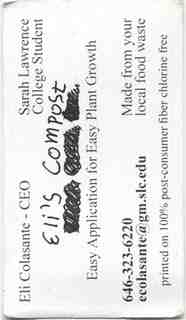
Current Business Card

I just hand this on the back of one of the old business cards,
had the image scanned, and then printed. I think the handwritten
feel is much more local, down-to-Earth, and the way I like it.

Business Cards

This is the same card. It has a back. It had
Too much information, and was not printed
on recycled paper. Also, SLC made me get rid of
the name SLC Composting because of "Legal Issues"


My very first business card ever was just a microsoft word document on which I printed several "cards" and cut them with a scissors. I can remember the days I felt so special for having these types of cards too. I went through a lot of different names for this composting facility. First was SLC Composting, then Worm Compost, Inc. (I think), then some other names I can't remember, and then onto the business cards that said SLC Composting. I resorted back to these after SLC would no longer allow me to use that name SLC Composting. Then I tried SLEA black gold for (Sarah Lawrence Environmental Action). Then it was Black Gold, Inc.. After that we evolved to ECOlasante Compost briefly, and then to the current Eli's Compost.
A close-up of the microsoft word
Document I made


The very first business card to actually get
printed on a real card. I only paid for the
shipping on these guys.


Here are some of the Business cards of the past... The classics!! I'll post up the one that's most current now!! Before these cards existed, I had slips of paper. Those got me to this really awesome contest with a bunch of other contestants with the Economist Magazine in Washington DC. The current one will be up in the next post!

I was going to incorporate this, and I did, but

now I've changed that and am going for a club
at SLC. I think it will be a not-for-profit once it grows, 
but for now, I like the collaborative, club atmosphere
and the idea of just integrating it with class curricula
at SLC. It will still run like a business in the sense of
keeping costs below revenues, but I don't plan on paying
myself or anyone else. Not until it can actually make the money


Thursday, July 28, 2011

Wednesday, July 27, 2011

Types of Methane Digesters

Broadly speaking there are basically there different types of digesters- batch-feed digesters, continuous-feed, and hybrids. Continuous-feed digesters can take a constant flow of waste every day, while batch-feed digesters take all of the waste at once. During the time of a batch-feed digester, no more waste can get accepted (House 140-142). At Sarah Lawrence, because there is a large amount of food waste being generated every day, it is pretty obvious that a continuous-feed digester will be the best type. There are however many different types of methane digesters. Some, such as the Upflow Anaerobic Sludge Blanket reactor (UASB), Expanded Granular Sludge Bed (EGSB) reactor, the Anaerobic Continuous Stirred Tank Reactor (CSTR), the Anaerobic Baffled Reactor (ABR), Plug-Flow Digesters, Covered Lagoons, Complete Mix, Fixed Film, a Temperature Phased Anaerobic Digester (TPAD), among others I have yet to learn about have been installed with success in numerous locations. Other types are in more of the planning stage and may either produce hydrogen, a gas with more energy than hydrocarbons and that burns much cleaner, or Methane; however, there are hurdles that still need to be overcome in order for these to meet commercial success.
     Most of the reactors I have read about so far are meant to digest waste water or waste in a very dilute form. Plug-flow digesters, so far, seem to be the only type that can function without the need for a large amount of water-handling cow manure at a consistency about as thick as ground-up food waste.

Works Cited

House, David The Complete Biogas Handbook. Alternative House Information, 2010.

Fang, Herbert H.P. Environmental Anaerobic Technology: Applications and New Developments. London: Imperial College Press, 2010. 113-136.